We Sell Both
2026 Jeep Cherokee vs Compass
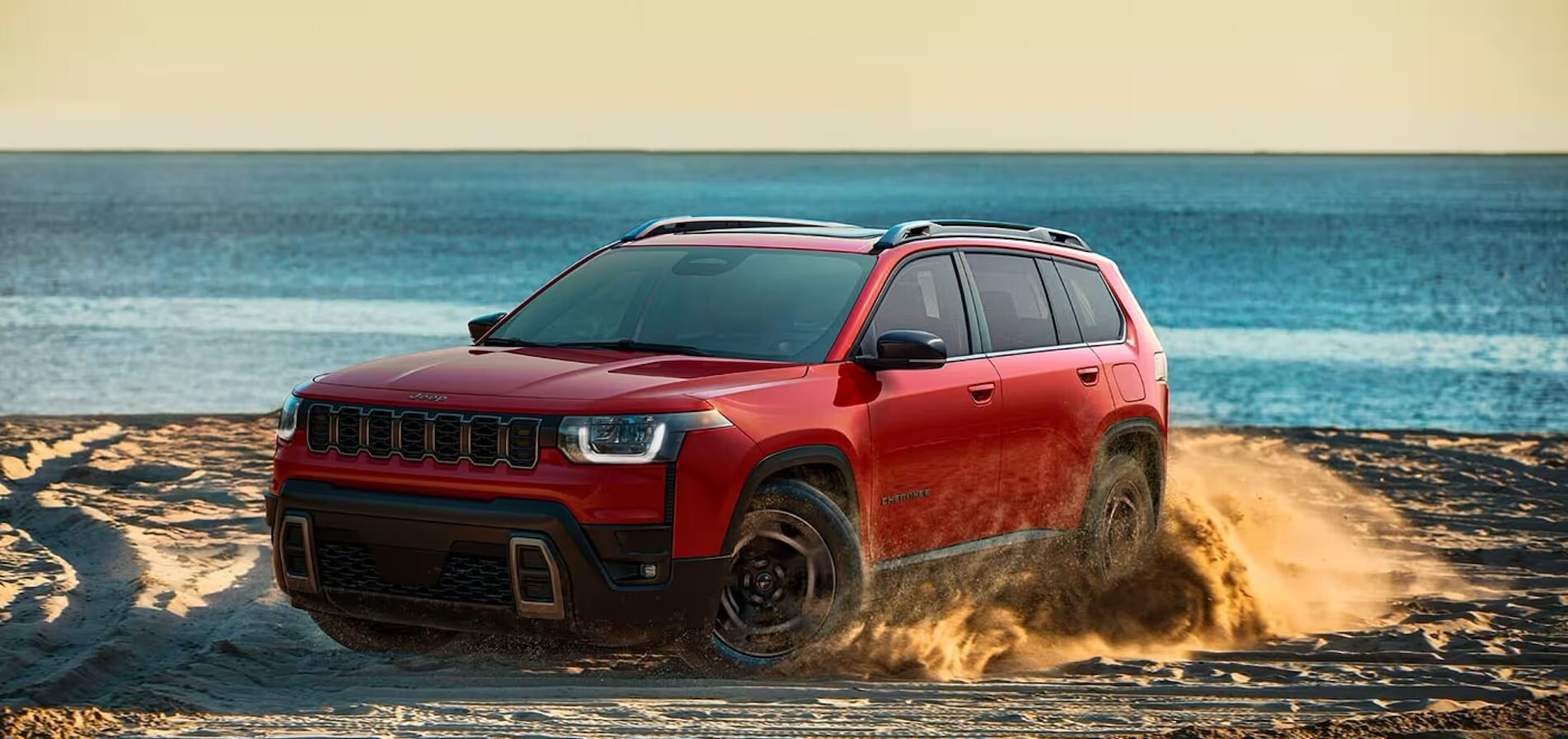
The Compass gets you into a four-wheel-drive Jeep for $5,450 less. The Cherokee gives you 14.7 inches more vehicle, 6.4 more cubic feet behind the second row and 37 MPG combined. Both are 4x4 on every trim.
Quick Take
- The Compass Latitude starts at $29,550 excluding destination; the Cherokee starts at $35,000 on the same basis, a $5,450 difference.
- Both carry four-wheel drive as standard equipment on every trim, so neither asks you to pay extra for it.
- The Cherokee is a hybrid rated 37 MPG combined; the Compass runs a 200-horsepower 2.0L turbo four rated 26 MPG combined.
- The Cherokee is 14.7 inches longer with 6.4 more cubic feet behind the second row and 8.5 more with the seats folded.
- The Compass Trailhawk is the only one of the two with a low-range transfer case, Rock mode, four skid plates and 19 inches of water fording.
A household choosing between these two is really choosing between the money it takes to get in and the room it takes to live with, and on a peninsula where the same vehicle does the school run and the dump run, that trade is decided by the second row. Premier Cape Cod sells both in Hyannis. Both sides are quoted before destination, which runs $1,995 whichever way you go.
2026 Compass vs Cherokee: Overview
2026 Jeep Compass
The smaller, less expensive Jeep, and the one with a genuine off-road branch at the top of its range. Every 2026 Compass runs a 2.0-liter turbocharged four making 200 horsepower at 5,000 rpm, through an eight-speed automatic, and every one is four-wheel drive. Six trims run from the Latitude at $29,550 to the Limited Altitude at $35,555 excluding destination, and the ladder is not strictly ordered by name: the Trailhawk sits at $34,060, below the Limited Altitude, because it is a capability trim rather than a luxury one. It measures 173.4 inches long on a 103.8-inch wheelbase, seats five, carries 27.2 cubic feet behind the second row and 59.8 with that row folded, and is rated 23 city, 31 highway and 26 combined MPG.
2026 Jeep Cherokee
The larger, newer and more efficient of the two, built on one powertrain with no alternatives. One powertrain, no alternatives: a 1.6-liter turbocharged four paired with two electric motors and a battery, good for a combined 210 horsepower and 230 lb-ft, sent through a continuously variable transaxle to Jeep Active Drive I four-wheel drive with a rear-axle disconnect. Five trims run from $35,000 to $43,000 excluding destination. It measures 188.1 inches long on a 113.0-inch wheelbase, seats five, carries 33.6 cubic feet behind the second row and 68.3 with the bench folded, and is rated 39 city, 35 highway and 37 combined MPG with more than 500 miles of range from a 13.7-gallon tank. Its trailer ceiling is 3,500 pounds, conventional hitch, properly equipped.
Powertrain and Capability Compared
| Specification | 2026 Jeep Compass | 2026 Jeep Cherokee |
|---|
| Engine | 2.0L I4 turbo with stop/start | 1.6L I4 Turbo Hybrid |
| Horsepower | 200 hp at 5,000 rpm | 210 hp combined system output |
| Torque | Peak torque held from low revs to the middle of the range | 230 lb-ft combined system output |
| Transmission | Eight-speed automatic | Continuously variable transaxle |
| Drivetrain | Jeep Active Drive four-wheel drive, standard on every trim; Active Drive Low with a 20:1 crawl ratio on the Trailhawk | Active Drive I 4x4 and its rear-axle disconnect, fitted to all five |
| EPA combined MPG | 26 MPG (23 city / 31 highway) | 37 MPG (39 city / 35 highway) |
| Maximum towing | 2,000 lbs, conventional hitch, properly equipped, Trailhawk with the Trailer-Tow Group | 3,500 lbs, conventional hitch, properly equipped |
| Ground clearance | 8.1 in, rising to 8.6 in on the Trailhawk | 8.0 in |
| Water fording | 16 in, rising to 19 in on the Trailhawk | Jeep publishes no fording figure for this vehicle |
EPA estimates per fueleconomy.gov, taken straight from each rating body. Two scope notes that matter more than they look. The Compass tow rating belongs to the Trailhawk with the Trailer-Tow Group fitted and to no other trim, so it is not a Compass-wide figure. And both figures sit on the same conventional-hitch, properly-equipped basis, which is what makes the 1,500-pound difference between them a real comparison rather than an apples-to-oranges one.
Size and Space Compared
| Dimension | Compass | Cherokee |
|---|
| Overall length | 173.4 in | 188.1 in |
| Wheelbase | 103.8 in | 113.0 in |
| Width excluding mirrors | 73.8 in | 74.7 in |
| Height | 64.8 in | 67.5 in |
| Cargo behind the second row | 27.2 cu ft | 33.6 cu ft |
| Maximum cargo | 59.8 cu ft | 68.3 cu ft |
| Rear legroom (second row) | 38.3 in | 38.5 in |
| Seating | 5, two rows | 5, two rows |
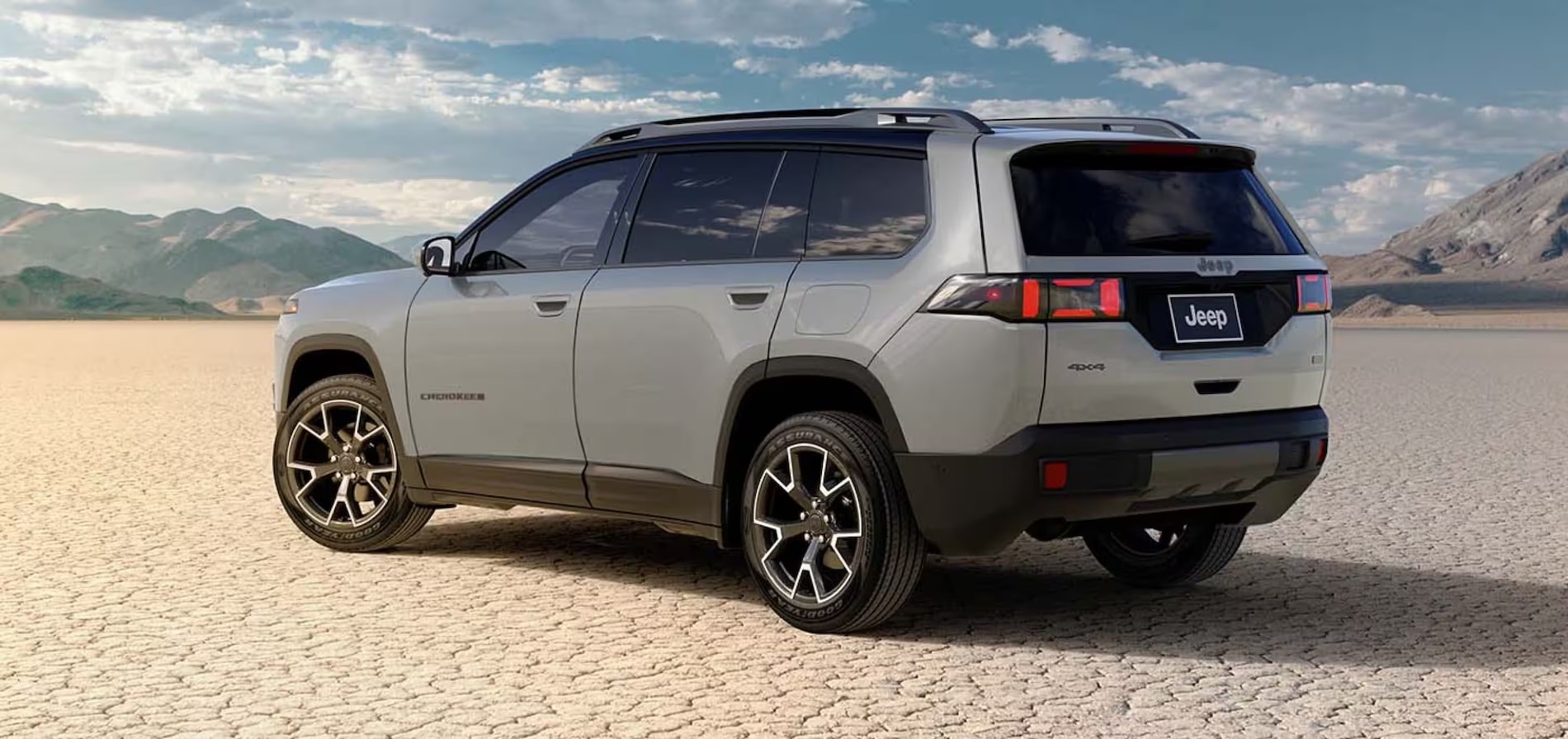
The interesting line is second-row leg room, where the two are within two tenths of an inch of each other. The Cherokee's 14.7 extra inches of length go almost entirely into the cargo area rather than into the back seat, which is why the gap behind the second row is 6.4 cubic feet and the gap between the knees is not really a gap at all. If the decision is about people, sit in both. If it is about what rides behind them, the table has already answered it.
Pricing Compared
| Figure, excluding destination | Compass | Cherokee |
|---|
| Entry price | $29,550 (Latitude) | $35,000 |
| Top published trim price | $35,555 (Limited Altitude) | $43,000 (Overland) |
| The capability trim | $34,060 (Trailhawk) | No separate off-road trim in the range |
| Destination charge in the price | $1,995 | $1,995 |
| Trim count | Six | Five |
| Basic warranty | 3 years / 36,000 miles | 3 years / 36,000 miles |
| Powertrain warranty | 5 years / 60,000 miles | 5 yr / 60,000 mi powertrain; 8 yr / 100,000 mi on the hybrid battery |
Neither column carries destination, and destination is $1,995 whichever one you buy, so the $5,450 gap at the entry point is real money rather than a basis mismatch. Notice where the two ranges overlap: a top Compass at $35,555 costs more than an entry Cherokee at $35,000. That overlap, not the headline gap, is where most of these decisions actually get made.
Where Each Car Wins
Where the Compass wins
The price of entry. $29,550 against $35,000, both excluding destination, and four-wheel drive is standard on the Compass at that price too. That is the single strongest argument in this comparison.
Real off-road hardware at the top. The Trailhawk has Jeep Active Drive Low with a 20:1 crawl ratio, a Rock mode the other trims do not get, hill descent control, four underbody skid plates protecting the front suspension, fuel tank, transfer case and transmission, red tow hooks, Falken WildPeak all-terrain tires and a full-size spare. Nothing in the Cherokee range answers that list.
Water fording. 16 inches on the four-wheel-drive trims and 19 inches on the Trailhawk. There is no published fording depth for the Cherokee.
Footprint. 14.7 inches shorter and 2.7 inches lower, turning inside 17.7 feet on the Trailhawk. In a summer parking lot or an older garage bay, smaller is simply easier.
More ways to spec it. Six trims against five, including two Altitude appearance trims and an 85th Anniversary Edition, so there are more places to land between the bottom and the top of the range.
Where the Cherokee wins
Fuel economy, by 11 MPG combined. 37 against 26. Over a year of Cape driving that is the largest single running-cost difference between these two vehicles, and the EPA puts the Cherokee's annual fuel bill at $1,650.
Cargo, by a real margin. Behind the second row: 33.6 cubic feet to the Compass's 27.2. Seats down: 68.3 to 59.8. The extra length goes where it is useful.
Towing. 3,500 pounds to 2,000, conventional hitch and properly equipped on both sides. The difference is who gets it: every Cherokee trim, versus a Compass Trailhawk with the tow group.
Range. It goes more than 500 miles between fill-ups. That is a peninsula-specific advantage: fewer stops, and less thought about where the open station is on a February Sunday.
The screen does not shrink on the cheap one. Every Cherokee trim, entry car included, gets the 12.3-inch Uconnect 5 touchscreen. On the Compass the 10.1-inch screen is standard on four of six trims, with the two Latitude trims starting from an 8.4-inch unit.
A Note on Crash-Test Ratings
On driver assistance the Cherokee arrives fully equipped from the entry trim: Active Driving Assist pairing lane centering with adaptive cruise, automatic emergency braking that identifies pedestrians and cyclists, intersection collision assist, blind-spot monitoring with rear cross-path detection, lane keep assist and rear park assist with rear automatic braking, all standard on all five trims.
Which One Fits You?
You want a four-wheel-drive Jeep for the least money. Compass, at $29,550 excluding destination with 4x4 standard. See Compass inventory.
You want low range, Rock mode and skid plates. Compass Trailhawk. It is the only vehicle here with that hardware, and it is a different machine underneath rather than a trim level.
You drive a lot of miles. Cherokee, at 37 MPG combined against 26 and more than 500 miles of range. See Cherokee inventory.
The cargo area is the deciding factor. Cherokee, by 6.4 cubic feet behind the second row and 8.5 with the seats folded. Bring the stroller or the crate and settle it in the lot.
You tow a small trailer. Cherokee, at 3,500 pounds properly equipped against 2,000, and without needing a particular trim to get there.
Your budget lands right at $35,000. That is the overlap, and it is a genuine choice: a top-spec Compass with the equipment finished, or an entry Cherokee with more space and better economy. Drive both.
Shop Both at Premier Cape Cod
Both are on the lot at 556 Yarmouth Rd in Hyannis, off Route 132, an easy drive from Falmouth, down the South Shore from Plymouth, or from anywhere in Barnstable. Across Barnstable the Cherokee is the one people come back for, on room alone. This is a comparison that resolves fast in person, because the difference is mostly physical: park them side by side and the 14.7 inches is obvious, then open both tailgates and the cargo gap stops being a number. If the Trailhawk's hardware is what interests you, ask to see one, because a photograph does not show a skid plate. Our customers come from all over the Cape, plus Falmouth and Plymouth, and this particular pair lands on the desk most weeks.
The fastest way to settle it is to sit in both on the same afternoon. Call (508) 815-5000 to line up a back-to-back drive, or get pre-approved and value your trade first.
Cherokee vs Compass FAQs
Is the Cherokee bigger than the Compass?
Yes, by 14.7 inches of length and 9.2 inches of wheelbase, and it stands 2.7 inches taller. The width is nearly the same, at 74.7 inches against 73.8. Most of the extra length goes into cargo: 33.6 cubic feet behind the second row against 27.2.
How much cheaper is the Compass?
The entry gap is $5,450: $29,550 to $35,000, neither figure carrying the $1,995 destination charge that both vehicles share. The ranges overlap at the top, though: a Limited Altitude Compass at $35,555 costs more than an entry Cherokee.
Are both of them four-wheel drive?
Yes, and on every trim of both. There is no front-drive Compass and no front-drive Cherokee for 2026. The Compass Trailhawk goes further with Jeep Active Drive Low and a 20:1 crawl ratio; the Cherokee uses Active Drive I with a rear-axle disconnect on all five trims.
Which is better off-road?
For genuine trail work, the Compass Trailhawk. It is the only one of the two with a low-range transfer case, a Rock driving mode, hill descent control, four underbody skid plates, red tow hooks and all-terrain tires, and it fords 19 inches of water against 16 on the other Compass trims. With 8.0 inches of clearance and a Sand/Mud mode the Cherokee handles weather well, but the low-range branch is not on its menu.
Which gets better fuel economy?
The Cherokee, by 11 MPG combined: 37 against 26. Its city figure of 39 is higher than its highway figure of 35, which is the signature of its hybrid system and the reason the gap is widest in summer traffic.
Can the Compass tow?
The Trailhawk fitted with the Trailer-Tow Group is rated at 2,000 pounds on a conventional hitch, properly equipped. That rating belongs to the Trailhawk and the group; it is not a Compass-wide figure. The Cherokee is rated at 3,500 pounds on the same basis, on any trim with the tow group fitted.
Is the Compass a hybrid?
The 2026 US Compass runs a 2.0-liter turbocharged four with stop/start on every trim. Only one of these two is a hybrid. The Cherokee's 1.6L I4 Turbo Hybrid is fitted to each of its five trims. Ask us what is in stock, because inventory is the current answer on any electrified line-up.
Do rear-seat passengers get more room in the Cherokee?
Barely. Second-row leg room is 38.5 inches in the Cherokee and 38.3 in the Compass, two tenths of an inch apart. The extra 14.7 inches of Cherokee length go into the cargo area, not the back seat, so if the decision is about people rather than luggage the two are closer than their footprints suggest.
Park Them Side by Side
Both tailgates open in the same lot. That is the whole comparison in ninety seconds.